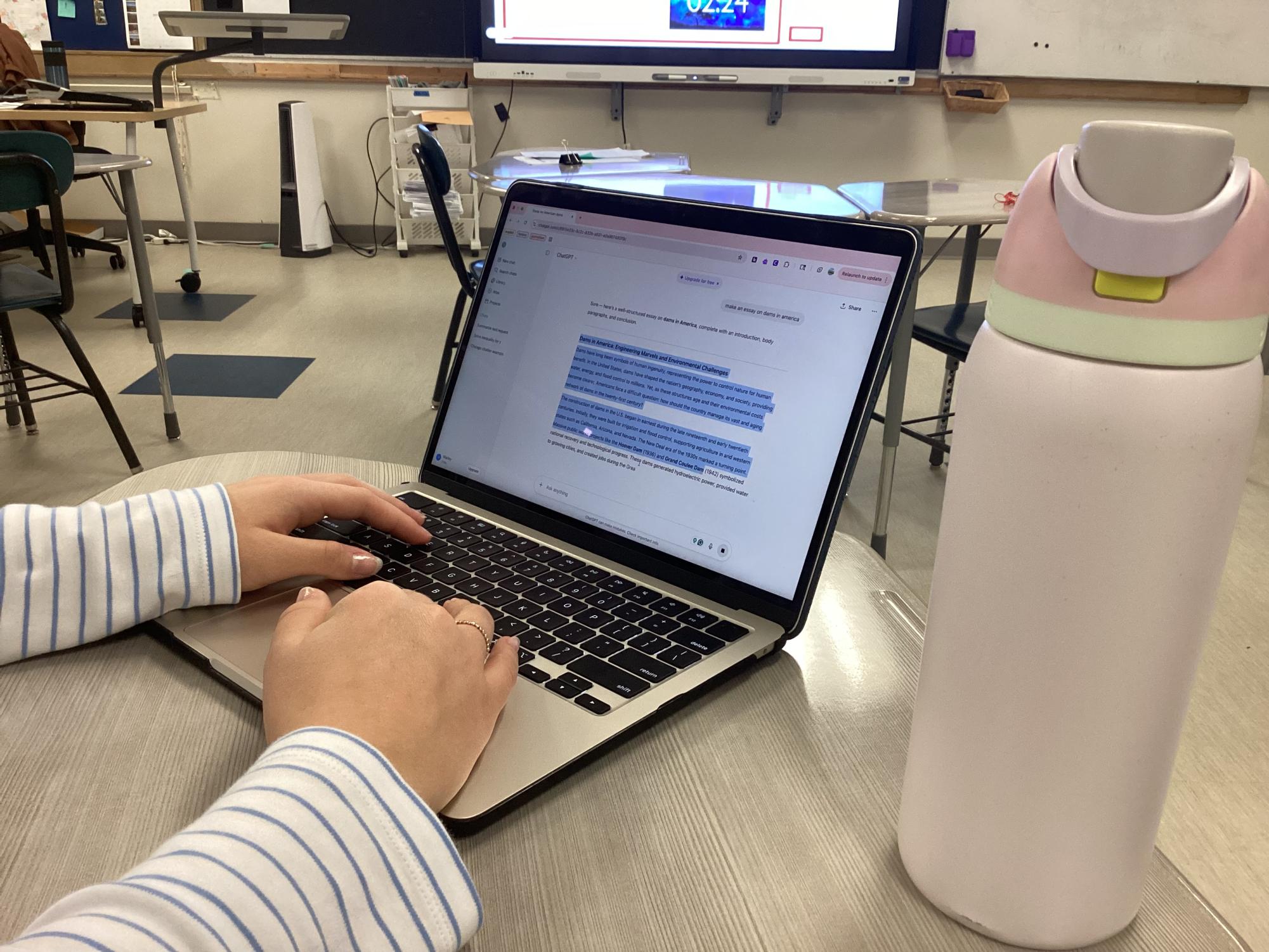
Since 2022, the world has been hearing growing concerns about AI. The Center for Democracy & Technology (CDT) found that 68% of schools nationwide have implemented policies to permit or ban the use of AI, and that number has continued to grow. As AI advances, both the learning and working environments will increasingly be subject to change, and we need to learn how to respond. The future will be full of AI, and it’s the job of students and teachers to start working with it, beginning with implementing AI education in schools.
The issue of AI education relates to the workplace and the new demand for technological skills. Businesses have been predicting that their use of AI will increase in the coming years. According to the 2023 Future of Jobs Report by the World Economic Forum, 75% of companies said they would be adapting to AI within the next five years.
A more recent World Economic Forum report revealed that 66% of teens are worried they will not be able to find good jobs because of AI. The Forum also predicts that AI will displace 92 million jobs, but will also create 170 million new ones. As a result, 39% of the skills employees are expected to have will change; companies will be looking more specifically for employees who know how to work with AI.
This highlights the need to teach students how to use AI. It’s crucial for students to be prepared for the future, not only for their jobs but also for their everyday lives.
However, not enough schools are teaching students to use AI appropriately. The Walton Family Foundation found that although teachers agree it is their job to prepare students for the future, 4 in 10 believe they are preparing students inadequately. There is a significant lack of knowledge concerning AI in the school environment; CDT reports that in 2023, only 48% of teachers received training on AI use.
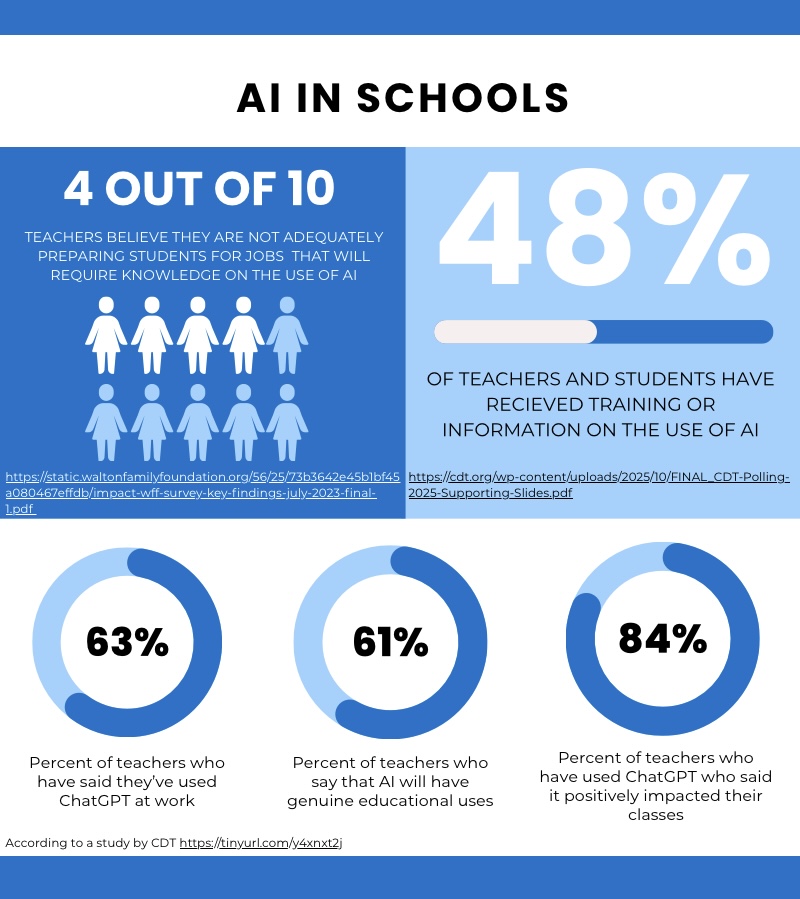
This is an enormous problem – if educators don’t know how to use AI, how will they have the ability to teach students how to navigate the use of AI? This creates a lack of knowledge in students as well; according to CDT, just 48% of students received any information on AI at all. Having AI included in the school curriculum and providing AI training for teachers would help increase the number of students learning about AI and might decrease the number of teens who are worried about their future.
Some people might say that students would rely too heavily on AI and use it incorrectly if it were available to them during school. However, addressing the risk of over-reliance on AI would benefit students. Students should learn academic integrity while the school is still supporting them, rather than later, in the workplace, where acting without integrity can have real-world consequences.
There are also developmental risks for those with excessive AI use. A study by MIT found that people who relied solely on AI had significantly weaker cognitive engagement and memory recall than those who relied on their own abilities.
Additionally, AI is not foolproof; it can often generate misleading or incorrect information. ChatGPT, for example, collects its data from public internet sources. This can mean that information ChatGPT believes to be true could be false, since not all sources on the internet are reliable.
Using AI can also pose a personal risk to users who aren’t aware of privacy concerns: AI collects data based on what is entered into its system.
It is up to schools to educate students about the risks of using AI, helping them to reduce the likelihood of incorrect use. Students who are more aware of the consequences of AI misuse will know how to fact-check AI, for example, and will avoid entering personal data into AI chatbots such as ChatGPT.
Another concern against using AI in school might be that teachers won’t be doing their job if they have access to AI, but it can actually be used to enrich learning and lessons. The Walton Family Foundation found that the majority of teachers who have used ChatGPT said that it positively impacted their teaching and classes, with 61% saying that AI will have legitimate educational benefits. This can include adapting material for lessons and creating personalized assignments for students. Using AI will be helpful for educators and can be a beneficial resource for students as well.
Pandora’s box has been opened; AI is here to stay. However, as long as students and teachers act with integrity and don’t depend on AI for the majority of their tasks, AI will be a valuable asset in the learning environment. AI can be used to complete mundane tasks, freeing people to handle those that require ethics or unique and creative solutions.
Moving forward, educators and school boards would be well-advised to implement AI in small ways throughout their curricula. Students should encourage school administration to update or change their AI policies to include AI education and acknowledge it as a classroom tool. The earlier we take advantage of AI and adapt its skills to our needs the better off we will be in the future.