
If we don’t compost now, then there will be serious consequences in the future. Massachusetts should require residents to compost.
Currently, Massachusetts requires that commercial buildings and places that sell food compost if they produce at least a half-ton of food waste. This is the only rule in Massachusetts that requires composting. There is no rule requiring all residents to compost.
According to the United States Environmental Protection Agency, composting is important because it reduces landfill waste by 30%. Composting turns food scraps into valuable soil, unlike what happens in landfills. In landfills, wasted food decomposes, releasing methane gas (a greenhouse gas) that is very bad for the atmosphere. Greenhouse gases are created by heat that enters the atmosphere, which is bad because the more heat in the atmosphere, the more global warming increases.
If residents don’t start composting now, it will have significant effects in the future. An example would be global warming, which leads to an increase in extreme weather events, disruptions to food and water supply, and health risks. Composting is one of the most powerful actions we can take to reduce our trash and increase healthy soil.
Some may argue that composting is too expensive. However, there is evidence that the cost per resident for a city or state to compost is manageable.
Furthermore, a specific program run in Ipswich demonstrates an affordable solution for residents. According to Ipswich’s Program, Ipswich residents have two options for composting: they can choose to pay an annual fee of $100 for weekly pickup or $ 70 every other week, per resident. Additionally, personal composters produce soil that is very useful and beneficial if you have a garden. These bins are around 100-150 dollars. This is a little pricey, but it is very convenient, and it benefits you and the environment.
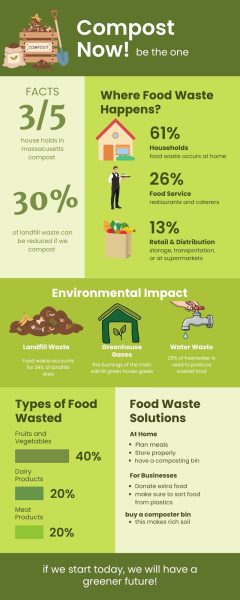
Massachusetts can look to other states as models, such as Vermont, which has made this work. According to Vermont Public, after the state made composting food scraps mandatory in 2020, they have seen drastic changes. The Department of Environmental Conservation stated that Vermont is doing very well. For residents, the cost is manageable; they pay about $9-22 per month for curbside compost pickup. Alternatively, residents have the option to buy a composter, which is a beneficial one-time purchase.
It will take time to organize something like this – possibly a few years – for these changes to be made.
You can start now by buying a composting bucket. The basics of composting at home are simple; you just separate your food, put it in the bin, and once it’s full, take it out to the curb for the trash company to pick it up if there is a program in place.
Additionally, to help change the laws so that states require residents to compost, you can support a local composting program through your local town or city. Some examples of this are signing a petition or contacting lawmakers. According to Mass.gov, the only current rule for composting in Massachusetts is that commercial buildings that sell food are required to compost.
It is up to everyone to protect the environment. Composting is efficient, easy, and great for the environment. Composting helps reduce climate change, increase fertile soil, and reduce waste in landfills.