
What is the right age for kids to get a cellphone? Research suggests that people aged 13 and older are the right age because they are more responsible than children under 13.
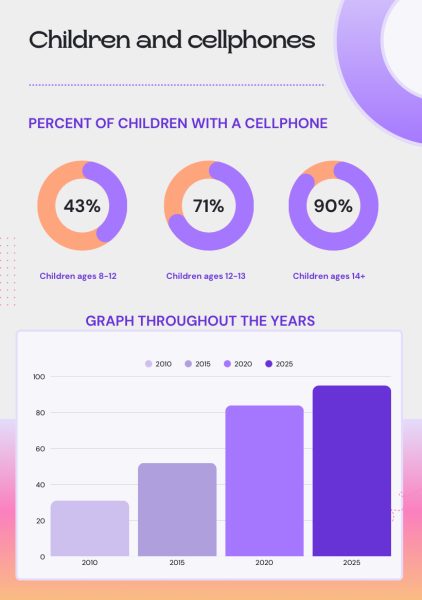
Recently, children have been receiving cellphones at increasingly young ages. Specifically, 43% of kids ages 8-12, 71% of kids ages 12-13, and 90+% of kids 14+ own a cellphone, according to the Child Mind Institute.
Why is this a problem? There are many negative effects of cellphones on the young brain.
According to Handspring, a virtual and in-person mental health practice, “early exposure to smartphones can lead to increased stress and distraction.”
This impacts kids’ and teens’ sleep, schoolwork, and overall social behavior. Handspring found that kids/teens have a harder time managing emotions, developing social skills, and having a good attention span.
Cellphones have a greater impact on younger children because the longer they own them, the more attached they become, which can lead to later problems.
One crucial problem is that phones often provide access to social media apps. The New York Times reports that children who grow up with social media become “more anxious, depressed, isolated, and unable to focus.” The article went on to say that roughly one-third of parents believe they gave their child access to social media too young.
Additionally, Handspring explains the positives of giving a phone at a later age. This includes kids being able to feel safer because they have a way of communication, and building responsibility by using the cellphone themselves.
Some parents argue that their kid needs a cellphone for safety, such as for parent-child communication. However, according to the book The Anxious Generation, “children need play that involves some risk to develop competence and overcome their childhood anxieties.”
This means that parents should withhold giving their child a cellphone, so their child can have more freedom during childhood instead of being strangled by social media.
Others might say that cellphones can teach valuable skills such as digital etiquette, time management, and the importance of balancing screen time.
While this is true, when children have cellphones, they can get exposed to social media, and it can lead to peer pressure, cyberbullying, and more.
So what can be done about this issue? For parents, after giving your child a phone, it is helpful to check in regularly and educate your child about social media.
Parents need to remember that during childhood, “positive experiences and environments can set up a young child on a stronger life path,” according to DHHS.
It would be more beneficial to wait until age 13 before giving children cellphones. Children need to enjoy their childhood, screen-free, while they can.
The parents’ goal of waiting to give their children cellphones at an older age is not to make them feel left out or excluded, the New York Times says, “It’s much bigger than that. The goal is to restore childhood.”