Ever see a forecast for 15 inches of snow, but only get six? It makes one wonder why forecasts can be wrong. Weather prediction relies on complex computer models, but even the best technology cannot perfectly predict the weather.
Meteorologist Andy Nash has worked for the National Weather Service for 33 years and received his degrees in meteorology from the University of Hawaii. He explained that there are two basic groups of models: physics-based and statistical. Nash acknowledges that weather models have made significant progress in predicting weather events, but each model has its own strengths and weaknesses.
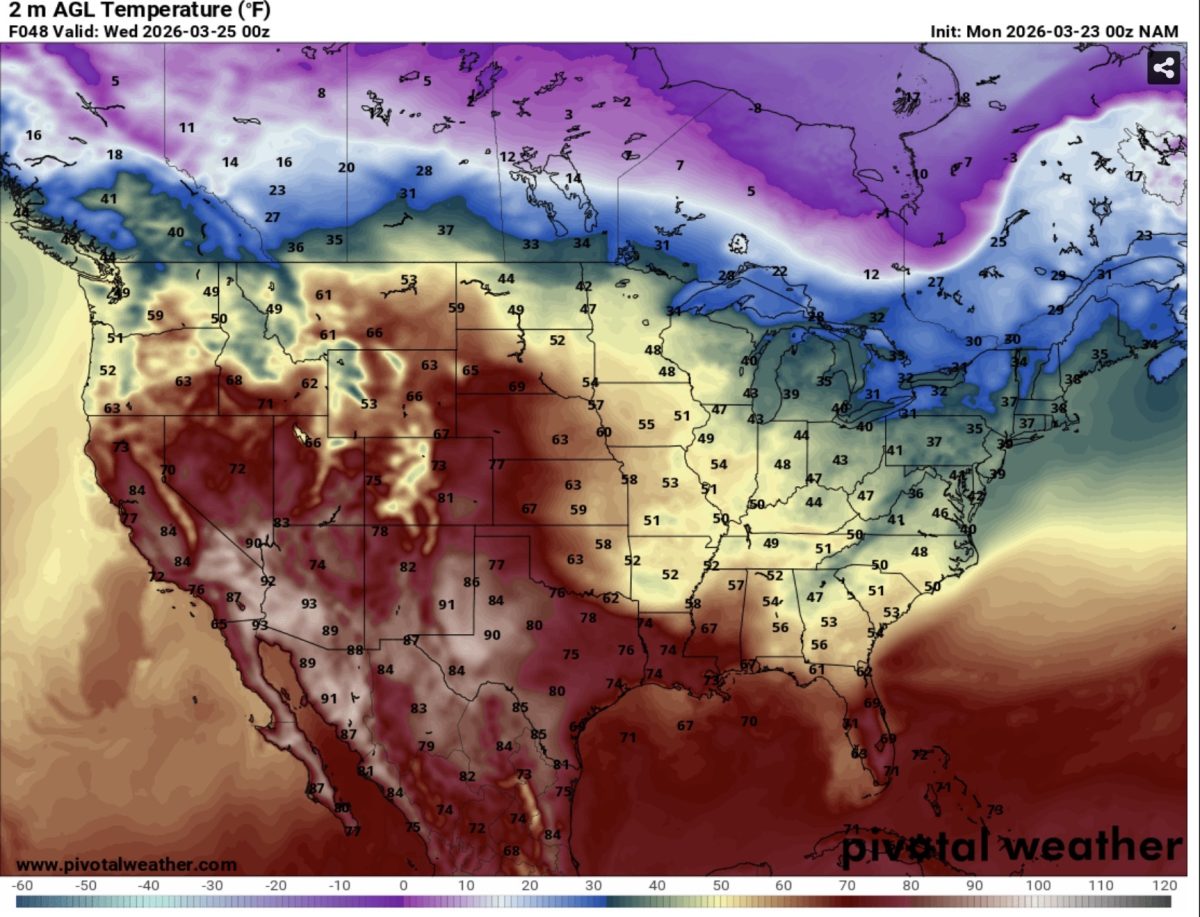
He says physics-based models, such as the GFS, ECMWF (commonly referred to as the Euro or European model), NAM, and the HRRR, “use physics equations of the atmosphere—motions, fluid dynamics, and other processes—to make a prediction for where air particles will move and what they will do.” The GFS model updates 4 times daily and focuses on speed and broader coverage, while the European model runs twice daily and is generally considered more accurate due to superior data assimilation and higher-resolution physics.
Statistical models, such as artificial intelligence-powered models, work differently. They “take all of the physics-based models, put them together, and run statistics on them. It is not generating its own forecast. It’s just taking all the models and averaging the inputs,” said Nash.
Nash mentioned that researchers are developing new AI-based models to help forecasters, describing them as “another flavor of statistics.” He added that “they can run really fast and don’t take as much processing power, so you can run the model a thousand times and see the range of possible outcomes much quicker.” These models analyze past data to provide a broader picture of what could happen in the atmosphere. Because these models focus on probabilities and ranges of outcomes, they highlight how forecasting involves uncertainty rather than exact predictions.
Nash also said that forecasting accuracy had improved significantly over time. For example, the Blizzard of 1993 was a major winter storm that marked a milestone in forecasting, where models accurately predicted a large incoming storm. Before then, models could only produce a reliable forecast up to three days in advance. Today, forecasts are often accurate up to five days in advance.
Many people have seen the 10-day forecasts advertised on weather apps and TV, but Nash said those long-range forecasts should be interpreted carefully: “Ten or fifteen days out, it’s not going to be accurate for a specific location.” However, it may still show broader regional patterns, such as whether temperatures will be warmer than normal.
He also noted that the difference between precision and accuracy is something that most do not understand. The models may give people an exact number (precision), but it may not be within 10 degrees of the actual temperature (accuracy).
Nash went on to say, “If it were all rain, nobody would notice a difference… However, that error is magnified when you make the precipitation snow because people can see how it piles up.” This is one of the main reasons why snowfall forecasts can sometimes appear inaccurate.
Nash explained that factors such as moisture, temperature, and the way snowflakes form—known as microphysics—all influence snowfall totals. However, “the specific microphysics that are happening are always unknown, so meteorologists make assumptions.” Although all models produce guidance, their outputs still require interpretation. Nash acknowledges these challenges, saying, “No weather model is accurate, but some are useful.”
For students interested in meteorology, Nash recommends the COMET site, an educational website that provides free information on weather forecasting, atmospheric sciences, and next steps.