
When you step into the Wenham Museum on a quiet morning, you notice the sounds first: children laughing as they race toward the train room, the soft clack of wooden train wheels along the tracks, a toddler squealing as she peers into a dollhouse display case. In the textile gallery, a parent kneels beside a child, murmuring instructions as small fingers trace the lines of an antique pattern. For a brief moment, the past and present feel layered, folding softly into one another.
This is exactly the kind of experience Sarah Sosa-Acevedo, who became the Wenham Museum Director in February of last year, wants every visitor to have.
Her own love of museums began with a sense of awe she can still feel in her bones.
“I went to my first museum at the age of 12, and was blown away. It was a replica museum. Stepping into the gallery… I just stood there in silence, and felt a sense of reverence… It was just a very visceral feeling, and I think that sort of set the stage for what was going to come next… So, after that experience, I went to every museum I could get into.”
Yet Sosa-Acevedo didn’t always imagine herself working inside museum walls.
“When I went to university, the plan was… to be an architect. I thought, ‘I’ll design the museum shell—the building.’ But careers typically aren’t linear… So after a few twists and turns, I found my way to museum work, and I’ve never left.”
What began as a winding path eventually led her to one of the largest and most influential museum institutions in the world.
Smithsonian Experience and Professional Expertise
For Sosa-Acevedo, her time at the Smithsonian Institution in Washington, D.C. was a defining experience that shaped her approach to museum leadership.
“When I started at the Smithsonian, I actually came through the Smithsonian Latino Center. That center is now the National Museum of the American Latino, which is one of the two new museums that will be built on the National Mall in D.C. I came in at the outset of that project and worked on the first permanent Latino gallery on the National Mall, which is called the Molina Family Latino Gallery.”
The gallery began as a project within the National Museum of American History and later became the driving force behind the approval of the future Museum of the American Latino.
The Molina Family Latino Gallery took 14 years to design and install, opening to the public in June of 2022. Sosa-Acevedo worked on the project during its final four years.
“It was a 24 million dollar campaign and, by the end of the fundraising, we raised roughly 28 million dollars.”
The gallery remains the highlight of her Smithsonian career.
“I am just so proud—not only of the hard work that went into creating that gallery—but that it was the turning point for getting the Museum of the American Latino approved and now being built.”
That work is deeply personal for Sosa-Acevedo.
“I’m from Puerto Rico, born and raised,” she says, noting how cultural expression—whether through museums or music—shapes identity.
Beyond her personal passions, Sosa-Acevedo has devoted twenty-one years to museums.
“I’ve worked in every department of a museum. I started out as a volunteer, then I moved up to an intern, then I started at the front desk selling tickets and, in my 21-year career, I’ve worked every position,” she says. “I understand a museum’s ecosystem—how one department impacts the other and the back and forth that constantly goes into making an organization like this work. But it all started with my experiences volunteering and interning.”
It also began with Sosa-Acevedo’s first college trip to Paris when she stood on the staircase of the Louvre.
“I remember standing before the Winged Victory of Samothrace… seeing something that was from my art history books, and having that moment. Any time I experience that—seeing something in person that I’ve only known through images—it knocks the wind out of me.”
The experience sparked a lifelong habit of exploring museums.
“I go to a lot of museums every month. I study museums. I live them… I love seeing new exhibits—the care that went into designing them, the colors the curator chose, the objects they selected, and the stories they are telling.”
These excursions have directly informed Sosa-Acevedo’s vision for the Wenham Museum.
A Vision for the Wenham Museum
One idea Sosa-Acevedo has long dreamed of implementing is opening the entire second floor of the Wenham Museum as a visible storage space. Most museums keep more than 90 percent of their collections out of sight. Visible storage reverses that model, allowing visitors to see preservation, cataloging, and research happening in real time.
“These objects belong to our community,” she explains. “When people can see them, ask questions, and watch us care for them, they understand that museums aren’t just about exhibits—they’re about learning, stewardship, and curiosity.”
That same philosophy of transparency and engagement shapes the museum’s exhibitions.
The Wenham Museum’s exhibition, which opened this November, Step Right Up: Let’s Go to the Circus, exemplifies this approach.
“It’s a great model of what we do,” Sosa-Acevedo says. “There are hands-on components, history, learning, and we were able to wrap in North Shore history. It really hits everything we like to do as a museum.”
Hands-On Learning for All Ages
The Wenham Museum is intentionally kid-friendly. Children can operate model trains, step inside playhouses, ride a rocking horse, race toy cars down ramps, and dress up for imaginative play.
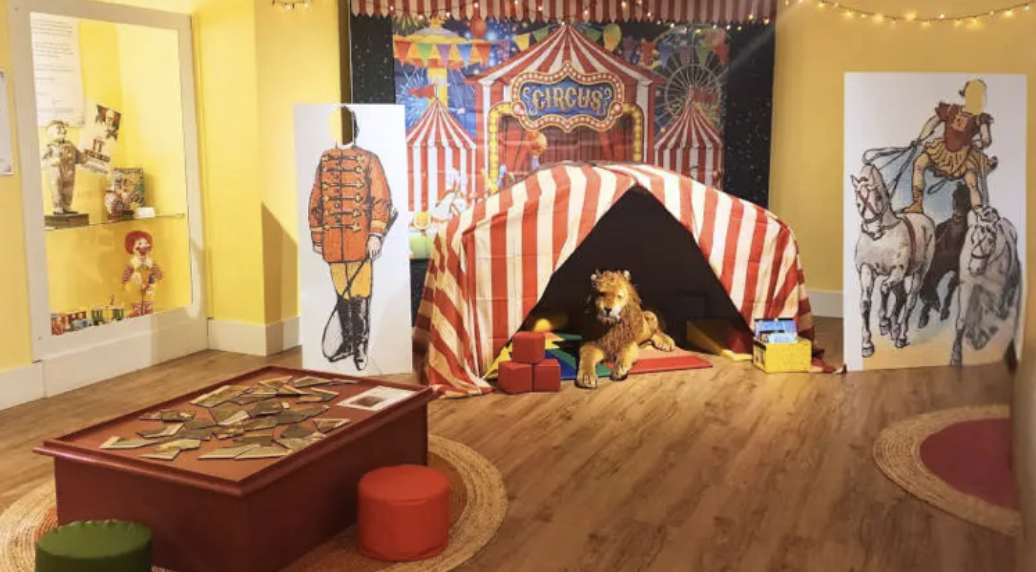
In the circus gallery, children duck beneath a colorful tent and dive straight into dramatic play, trying on costumes, peering into funhouse mirrors, caring for circus animals, piecing together giant puzzles, and building clown faces from bold shapes and colors. What begins as play quickly becomes a multisensory introduction to circus history.
The transformation, from curiosity to discovery, is exactly the point.
“I want visitors to…be wowed,” Sosa-Acevedo says. “I want them to think, ‘Oh, I didn’t expect to learn all that.’”
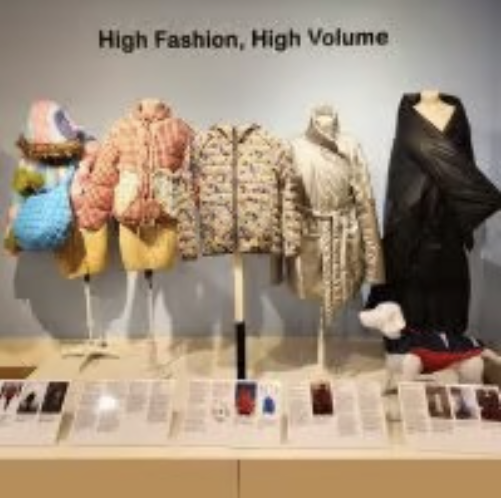
It is a philosophy that extends to quieter galleries as well, particularly the textile and costume collection.
“You can take a dress and tell so much about the woman who wore it—her social life, her status, her choices. From fabric and color alone, you can read a life. It’s a snapshot in history.”
For Sosa-Acevedo, those snapshots are never frozen.
“History is still happening,” she says. “Today is tomorrow’s history. We’re writing history now.”
Extending Learning Beyond the Museum Walls
Sosa-Acevedo brings her commitment to learning outside the museum walls, hoping to build richer educational experiences for visitors, especially young people in town.
“We can plug into the schools and collaborate with them,” she explains. “Sometimes teachers are limited either by resources or by what they can do in the classroom, and the museum can really help them amplify the reach of what they can do.”
She sees the Wenham Museum as part of a larger learning network within the community.
“We can collaborate with local libraries, we can collaborate with other nonprofits; we work a lot with homeschoolers, we work with Boy and Girl Scout troops,” she says. “So there are other non-traditional learning environments that can be amplified with the museum.”
By positioning the museum as a partner rather than a standalone institution, Sosa-Acevedo hopes to ensure that history, creativity, and curiosity remain accessible to learners of all kinds.
A Creative Life Beyond the Galleries
Outside of work, Sosa-Acevedo’s life remains just as creative. She speed-puzzles, reads constantly, and surrounds herself with art, design, and music. Everything she loves—Puerto Rican culture, architecture, storytelling, learning through doing—threads back into the museum.
Looking Ahead
Sosa-Acevedo’s philosophy will guide the Wenham Museum’s role in America’s 250th anniversary in July 2026.
“The museum considers itself an essential part of the celebration on the North Shore,” Sosa-Acevedo says.
She plans to curate multiple exhibitions and programs throughout the summer, with the main gallery dedicated entirely to the anniversary. Reenactors and interactive experiences will be central to the celebration.
“We’re going to be plugging into other people in the community who have plans,” she says, “so that we’re all working together to throw a big party for America.”
While national milestones draw people in, Sosa-Acevedo believes it’s everyday moments that keep history alive.
“You’ll see throughout the museum, we create spaces where grandparents can teach children,” she explains. “It’s different when history comes from your family. When a grandparent talks about the toys they played with or the catalogs they read, history isn’t distant—it’s personal.”
To keep the experience fresh, most exhibits are updated every few weeks.
“We’re preserving history, but presenting it in a modern context,” she says. “I like to say we’re nostalgic—but modern.”
Moments That Matter
In the end, what matters most are the quiet moments: a family lingering longer than expected, a child tugging a parent toward a favorite display, a visitor whispering, “I didn’t expect this.”
These are the moments Sosa-Acevedo works for—when history doesn’t sit silently behind glass, but breathes.
The Wenham Museum, located at 132 Main Street in Wenham, is open Wednesday through Saturday from 9 a.m. to 4 p.m. Those interested in visiting or volunteering can learn more at www.wenhammuseum.org.